
The overnight bus arrived in La Paz at 6am in the rain. We flagged a cab and headed straight to our hotel, Cruz de los Andes, which had been recommended by our travelling friends from the UK, Katie and Tom.
We arrived to find all of the steel shutters of the hotel closed but luckily, after some buzzing, the receptionist opened up and let us in. Our moods improved dramatically when he announced to us that our room was ready and that breakfast was ready and would be provided ‘on the house’. We managed a brief catch-up with Katie and Tom before they left to catch a bus to Copacabana (the “original” beach on lake Titicaca).


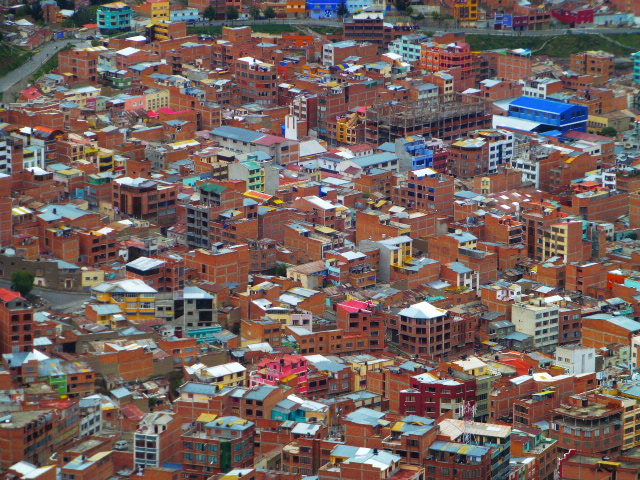
After a good rest, we started exploring the city. The city of La Paz rests in a bowl, surrounded by the high mountains of the Altiplano. As the city grew it started to climb the hills, resulting in varying elevations of 3,200m to 4,100m. In May 2015 the city was officially recognised as one of the New 7 Wonders cities, although we don’t really understand why.


That morning we trudged around the wet, cloggy streets taking in some of the main sites. In Plaza Murillo a guy came to sit next to us and was clearly clocking our belongings and the ones of the Asian tour group that were sitting next door. We upped and left and ended up sitting on the steps to watch all the pigeons.


After a “saltena” mid-morning snack, we visited the National Museum of Ethnography and Folklore, which showcased the regional particularities and unique characteristics of Bolivia’s independent cultures. It was very interesting and beautifully presented. We particularly enjoyed the hats room and the feathers exhibition.


The afternoon was spent exploring, including the Jaen street, which apparently has not changed since the colonial time. It was hard to imagine that La Paz used to be like that! Exhausted and somewhat underwhelmed, we resorted to eating pizza for dinner, on our bed, whilst watching a movie.


The next day, we woke up early, had breakfast and waited for our pick-up. Today was the day we were going to cycle the “Death Road”! The North Yungas road is a road linking the town of Corroico to La Paz. The largely single-lane road runs for 64kms and descends from 4,650m to 1,200m, with cliffs of up to 600m. In 1995 it was christened the world’s most dangerous road and it used to claim 200-300 lives per year. Nowadays, cars use a new, safer road and the route is almost exclusively enjoyed by thrill-seeking mountain bikers (not us).


With a full minivan of fellow thrill-seeking mountain bikers (2 Aussies, 1 Dutch, 1 German, and 3 Norwegians), we headed up to the 4,650m starting point. We geared-up and set-off down the first section – a relatively safe stretch of tarmac – with only the driving rain, thick fog and articulated traffic to contend with. After a little break and snack, we headed to the start of the “Death Road” proper.


Unfortunately, some type of strike by the local communities had temporarily closed the road. We were told it wouldn’t last long and all the locals wanted was money. We sat patiently, taking photos and staring nervously at the thin strip of gravel in front of us. After half an hour money exchanged hands, the locals removed the (rather lightweight) blockade and we were on our way.


As we set-off we were both thankful that we’d paid a slight supplement for superior bikes. Every now and then, we would stop and one of the guides would say be careful here because “…last December, the tourist who passed away went way too fast over here and lost control”… or “…when the road was closed, a minivan decided to come to this road and this is where they went too fast and slipped over the edge, resulting in four deaths…” or “…this is where a Japanese tourist slipped because he was taking a selfie…” (apparently he survived – the photo must have been impressive).
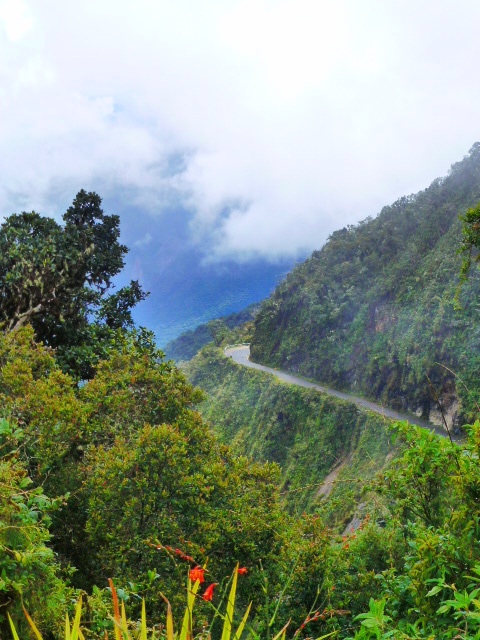
The Death Road was lots of fun and we regularly stopped to catch up with the group (or in Ed’s case allow the group (baring the crazy Aussies) to catch-up). All the boys first of course, followed by the girls. Lolo was quite proud to be one of fastest girls. Some of the stops included spectacular views or some cascades.


The more we descended, the warmer it was getting and slowly but surely, we started to shed the layers. There was only one part where we had to pedal a bit and we were delighted to receive a bottle of water after that stop because we were exhausted. When we finished, we all got our “I am a Death Road survivor” t-shirt and cracked open the beers (conveniently a woman had appeared with a coolbox just as we approached the minivan).


We were taken to a nice hotel for a shower, lunch and pool time and spent most of our time exchanging travelling tips with the rest of the group. The way back was very quiet as just about everybody was asleep.


That night, we were supposed to have diner with our friend Vanessa’s mother but the torrential rain had made the river overflow and she couldn’t get across the city. We ended up going to a ‘local’ restaurant for some Indian food, which was surprisingly good.

The following day, we decided to finally use the telefericos (cable cars) that we had been observing since we arrived. There are three lines: red, green and yellow and a project is underway to build many more. The debate around whether this is a good use of taxpayers money for a city with such poverty is open to debate but we really enjoyed the experience and seeing La Paz in this way completely transformed our impression of the city.

With the rain having finally subsided we agreed to meet Vanessa’s mum (and her friend) for lunch at Chalet La Suisse across town. Ed had a llama steak with a green peppercorn sauce and Lolo had trout with capers. Both were excellent and we had a wonderful time chatting with our hosts. They introduced us to a delicious drink called Chaufly, which was served long (and strong), mixed with pisco, lime and ginger ale. They also very generously paid for our lunch – thanks once again!


A simple teleferico (the green and yellow lines) later and we were back at the hotel, preparing ourselves for another feast – dinner would be back across town at a restaurant called Gustu, one of Bolivia’s finest and a long-overdue treat! The restaurant was created by Claus Meyer (one of the co-founders of Noma) as part of a wider project to promote gastronomy using Bolivian products.


Our amuse-bouche consisted of watermelon infused with cauliflower, which was original and delicious. This was very much a sign of things to come and we dived into the tasting menu, enjoying a host of wonderful dishes including caiman carpaccio and some delicious matched wines. Just about the best part of the evening was the bill, which amounted to little more than you’d expect to pay for dinner for two at an average London haunt.
Our final day in La Paz and we decided to go and visit the ruins of Tiwanaku (or Tihuanaco). It is still unclear in which civilization this was built, since carbon tests have given varying results. However, the ‘technology’ on display is impressive, from perfectly carved stones, with precise straight edges and 90-degree corners. There were stones that worked as speakers (obviously, we had to try it) and a very intelligent system of binding stones together, which involved using metal brackets – evidence of which is still clear to see.


Another feature observed from skeleton remains, suggests that the noble classes wore tight turbans around their heads from a very young age, which would deform the shape of their skulls into a cone. Check-out the latest Indian Jones film and you’ll see what we mean…


They were also famous for building anthropomorphic figures (stone statues). Unfortunately, many of them were destroyed by the Spaniards, who also used many of the stones of the site for their own construction. The other disappointment is that we weren’t allowed to take photos of the most impressive statues, which were huge but, alas, closely guarded by locals… you’ll have to “google-it”.


Our favorite sites were the sun gate and the area with all the heads (technical names). If you look hard, you’ll see that some of the heads look a bit like those of aliens.


Tour over, we were dropped at the local bus station to catch our bus to Copacabana. That ride was an adventure… we waited nearly an hour and a half for the bus which was “just around the corner”. Once it finally arrived, it was almost full and the seats we had selected were already occupied by hippies (yes, there were a lot on this bus with guitars and dreadlocks and everything…). The only available seats were on the back row and Ed was sat next to a very large lady who was wearing traditional costume (including braids and a fine set of gold teeth).


2-hours later the bus stopped at the edge of lake Titcaca, where, to save time, all of the tourists were told to disembark and catch a ferry across to the other side. The bus made its way across separately by barge. It was all very confusing since it was pitch black and all of the locals remained on the bus. With the help of Lolo’s neighbor we navigated our way across the lake, re-boarded the bus and eventually arrived in Copacabana.

Highlights:
- Descending the Death Road; no trip to Bolivia is complete without it
- Lunch with Vanessa’s mother and being introduced to the Chaufly
- The telefericos in La Paz, amazing views and the best way to get to know the city
- The ruins of Tihuanacu
Gastro Highlights:
- Diner at Gustu
 edandlolotravel