
We arrived in Potosi around midday following a local bus journey. It was an interesting experience to be surrounded by the locals and their families, carrying their big bags, containing anything from food to babies.
On the way we had to suffer the longest sales pitch ever (we timed it at over 1h30), presented by some eager young man, on the general health. He ended-up selling overpriced red, ginseng pills in mini plastic bags. Sad to say he sold quite a lot.

We arrived at the bus station and managed to get on a (very old and highly polluting) local micro (small mini-bus) that dropped us at 20m from our hostel (Eucalyptus). Our experience of navigating the local transport systems was paying off!
Potosi is the highest city of more than 100.000 inhabitants in the world and lies at an altitude of 4,100m. It was once the largest and richest city in the whole of Latin America. Its wealth and popularity as a city was fueled by its neighboring mountain, Cerro Rico (rich hill).


The story goes that a shepherd from Cuzco, looking for one of his llamas, sought refuge next to the mountain. He lit a fire and was surprised to see blue flames, which were caused by the presence of silver. This discovery fuelled one of the biggest wealth-rushes in history and Potosi was born.
Unfortunately, news of this wealth quickly reached Spain and by the mid-1500’s Cerro Rico was inhabited by slaves and its stash of silver was being extracted and used to bankroll the advance of the Spanish empire.


Cerro Rico attracts some shocking statistics. It is said to have claimed over 10 million lives and 7 million of these only 150 years after the Spanish arrived in Potosi.
Nowadays, tens of thousands of people continue to work in the mines, risking their lives extracting minerals (the silver is all but exhausted) for a few dollars a day. The working conditions are horrendous and loss of life is a far too regular occurrence. The question is: what happens once the mine is exhausted? Does Potosi become a ghost town? Watch this space…

Suffice to say, we did not take the tour of Cerro Rico, although we met others that did. “Shocking conditions”, “dangerous”, “those poor workers” and “so many holes it resembles a Gruyere cheese” were common descriptions. Our interest laid in the city itself and the history of its sad decline.
We kicked-off our Potosi tour with a visit to Casa Nacional de la Moneda (the National Mint). It is considered one of the finest museums in Latin America, let alone Bolivia. Constructed between 1753 and 1773 it controlled the minting of colonial coins and the restored building now houses everything from religious art to wooden minting machines.


The first mint was founded back in 1572 by the Vice King of Spain, Francisco Alvarez de Toledo, because the Casa de la Moneda in Lima could not cope with the huge quantities of silver sent from Potosi.
The coinage minted during its period became so well known in the world that a saying, memorialized by Miguel de Cervantes came into use: “valer un potosí” (to be worth a potosí means it is worth a fortune).
Ed was starting to feel the effects of altitude sickness, so the rest of the day was spent in the hostel, including dinner, which consisted of a few empanadas in bed.
The next day we continued our cultural tour, starting at the cathedral, which, rather sadly no longer has a functioning organ. Apparently some imposter did know how to use it and managed to break it. Calling all organ engineers – there’s a job for you in Potosi…


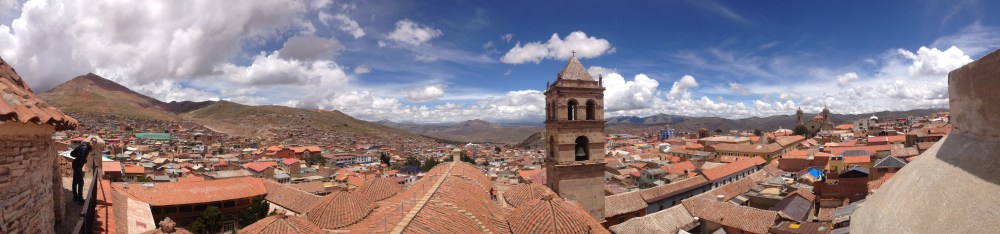
Next up was Convento de San Francisco, which was founded in 1547, making it the oldest monastery in Bolivia. The exhibit includes paintings, religious art and some fabulous views from the roof.
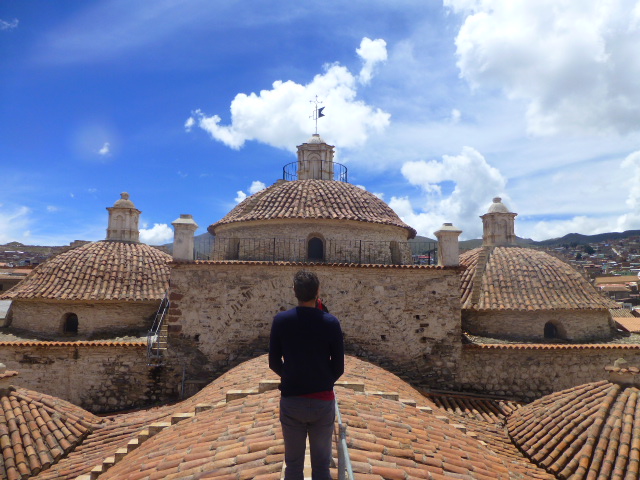
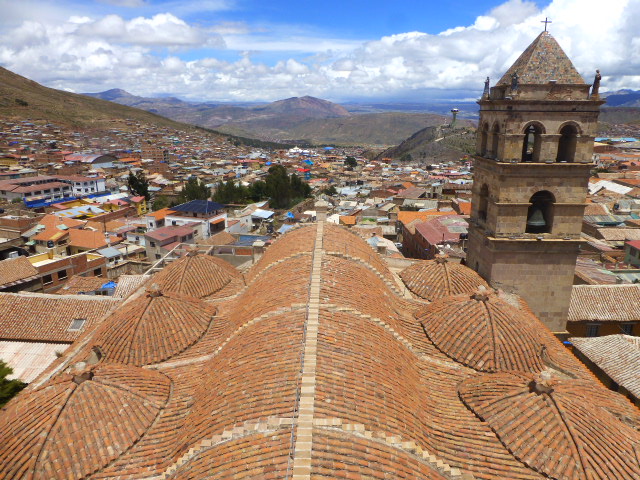
As if not content with the city view from the convent, our last cultural exploit had us climb the Tore de la Compania de Jesus. This beautiful bell tower is all that remains of the former Jesuit church, which was completed in 1707.


For lunch we sought out the best saltenas in town. Not the most healthy of snacks but these little pies were delicious. 4 down, we ambled back to the hostel and waited for our private car to arrive, which would take us to Sucre.


Our private transfer turned-out to be not so private and we joined 4 other people in a tiny Polo, to endure a boiling hot, 3 hour journey to Sucre. With hindsight, perhaps a bus would have been the sensible option.
Next stop: Sucre, Bolivia
Highlights:
- The views over the Potosi rooftops
- The imposing Cerro Rico – its history and the grip it has always maintained over the people of the city
Gastro highlights:
- Hardly haute cuisine but those saltenas were delicious!
Annoyance:
- The micros, which buzz around the steep, narrow streets, coughing black smoke everywhere
 edandlolotravel