
Our whirlwind first week concluded in Buenos Aires, a wonderful city of epic proportion. There are some 13 million people living in 48 barrios (districts). The 10 we managed to visit effectively make-up the ‘tourist map’, bookended by the respective stadia of River Plate football club to the north and Boca Juniors to the south. The grid system (a la New York) adds to the sense of enormity and for two people who enjoy getting lost in a city, we needed our full 4 days to find ourselves again!


We landed in Buenos Aires very late on the 7th but our bags arrived swiftly and we were soon being whisked away from the airport in the back of a cab. As a wedding present, our friend Josefina had kindly arranged for us to stay in an Airbnb apartment in the heart of Recoleta, a district just north of the centre, famous for its designer shops and enthusiastic dog-walkers (amongst other things).


On Friday morning we met up with Josefina for breakfast, over which she gave us the full debrief on what to do, what to see, where to go and where not to go – some of the districts on the tourist trail do have a reputation for crime, however, aside from the odd paranoid look over a shoulder, we didn’t have a problem.
Our first port of call was the Recoleta Cemetery, possibly Buenos Aires’s top tourist attraction, where generations of Argentina’s elite rest in ornate splendor. It is well known that you would have to spend a small fortune to secure your spot in this cemetery. Fortunately, however, for those still living it’s free to visit!


The cemetery is the resting place of some of Argentina’s leading celebrities, including Evita Peron, who is buried under her maiden name Duarte. We spent an hour navigating the narrow paths and marveling at the somewhat ostentatious structures, some big enough to conceal their own private chapels. It was quite incredible and despite getting quite ‘arty’ with the camera, our pictures really don’t do it justice.
Later that afternoon, we headed to Puerto Madero, principally to sort-out our boat crossings to and from Uruguay. However, we ended-up exploring these nineteenth-century docks, which have been redeveloped over the past twenty years and boast modern apartment blocks, bright-red restored warehouses, chic restaurants and museums. A little too reminiscent of canary wharf for Ed’s liking, we bought ice creams and decided to return home, via the centre of town.


The main square in Buenos Aires is Plaza de Mayo, where we sat and watched the tourists go by, being chased by young men on bicycles shouting “helados” (ice cream). This square has witnessed the best and worst moments of Argentina’s history, from hosting founding presidents to devastating military coups. At one end lies the Casa Rosada (the pink house), which is essentially the Argentinian version of the White House.


On the way home we stopped by Café Tortoni, which has seen over 150 years of service and formerly a favourite of many of the capital’s most successful writers and artists. The café is now a mecca for tourists and was so popular that they were operating a one-in; one-out policy when we arrived, so we had to queue. The café serves expensive coffee, hosts the odd tango show and has remarkably old furniture in the male loos (Ed was sent off to investigate). The golden mirrored walls are impressive and the staff surprisingly polite and engaging. It must be the allure of Ed’s improving Spanish – que bien!


Completely exhausted, we loaded-up on groceries, and shuffled-off home for dinner and an early night.
Ed had never set foot on a city tour bus before; a decision no doubt born by a stiff reluctance to give in to being a ‘real’ tourist. After a little debate, Ed bowed to his better half’s vast experience and agreed to a day of hop-on; hop-off.
Laurence emerged smiling from the queue with tickets, 2 maps, a bundle of money-off vouchers (that we never used) and a bottle of vino tinto (red wine) – best tour ever! All faith restored, we grabbed our headphones, hit the top-deck and set-off around BA.


First stop was Boca, the home of Boca Juniors football club and most notably formerly that of Maradona. After a quick snap of the stadium we re-boarded the bus, very much in agreement that this colourful area was worthy of more exploration.
Our bus took us back through Puerto Madero and we decided to hop-off for a coffee and visit our first gallery. The Amalia Lacroze De Fortabat art collection houses a significant portion of her extensive collection, including works by Dali, Chagall, Warhol and Turner. The building also had excellent air conditioning and feeling fresh and culturally inspired we jumped on the next bus and onwards north.


We couldn’t believe how much the districts seemed to differ from one another. One minute we’d be in the city centre, with tall concrete buildings, busy shopping streets and hoards of traffic, noise and people. 10 minutes later we’d be crawling through the leafy suburbs of Palermo and Belgrano, or the wide-open green spaces of the vast network of parks, north of the city centre. Amongst them various polo fields, private tennis clubs and the wonderfully opulent looking racetrack. Alas, there was no time for a day watching the nags (horses)…
Rounding the River Plate football stadium in the north, the bus turned back for the centre of town and our final stop, the famous opera house, Teatro Colon. Incidentally, en route we had concluded (well, Ed had concluded) that we were going to support Boca Juniors (instead of their arch rivals River Plate) on account of the more homely, underdog feeling of their stadium and surrounding district.


Teatro Colon was our final tour of a packed day. Lolo took pity and agreed we could go with an English guide, who turned out to be excellent and had us enquiring about tickets for anything we could get our hands on. Alas, the last performance of the season had been the Nutcracker on 27th December and they were now ‘on holiday’ until Valentine’s Day. Perhaps we’ll come back…


That evening we went OUT in Palermo, home to BA’s hippest restaurants, trendiest boutiques and liveliest nightlife. Sadly Don Julio – one of the finest parrilla in BA – was completely full and had attracted a long queue of people by the time we rocked-up at 10pm. Instead, we settled for jugs of sangria and burgers. After dinner we explored the streets and soaked-up the buzz of a Saturday night crowd. This was party central but too much hopping-on and hopping-off had taken its toll and we soon disappeared home, feeling slightly worse for wear!


The next morning we left the house at midday and headed for San Telmo, a district just north of Boca and famous for its cobbled streets and Sunday antiques market – the perfect place to aimlessly wander our hangovers away.


Being Sunday, Ed insisted on a decent Sunday lunch and we found a wonderful spot called El Maipu, which was packed full of locals, who were ordering Provoleta (melted cheese), grilled meat and jugs of the house wine. We left full of enthusiasm and promptly navigated the Museo de Arte Moderno (great exhibition by Marta Minujin) and then headed south to explore Boca and it’s famous “Caminito” – where people dance Tango on Sundays – and the Fundacion Proa.


Our favourite district was Palermo, which we returned to on Monday for lunch and a final flurry before leaving for Uruguay. Its quiet, tree-lined streets, boutique shops and restaurants reminded us of Notting Hill in many ways.


We sauntered home, packed-up our gear and headed for the Buquebus (literally boat-bus) terminal.
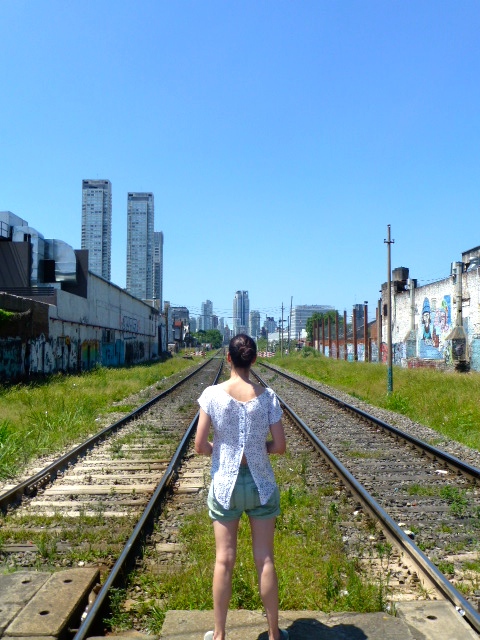
Next stop: Colonia del Sacramento, Uruguay
Highlights:
- Palermo – just a cool place that we would have loved to explore more of
- First Airbnb experience – thanks Josefina, what a generous gift
- The general vibe, what a wonderful city – reminded us of Paris, NewYork, Madrid and London. We will be back!
Gastro highlights:
- Lunch in Belgrano – a couple of slices of pie, enjoyed on a quiet park bench away from the madness (and the dreaded bus)
- Lunch at Maipu – relaxing with the locals while it was pissing with rain outside
- Las media-lunas – the local version of croissants; they are small enough to inhale and utterly delicious
 edandlolotravel